Hello, World — This Is My First Blog
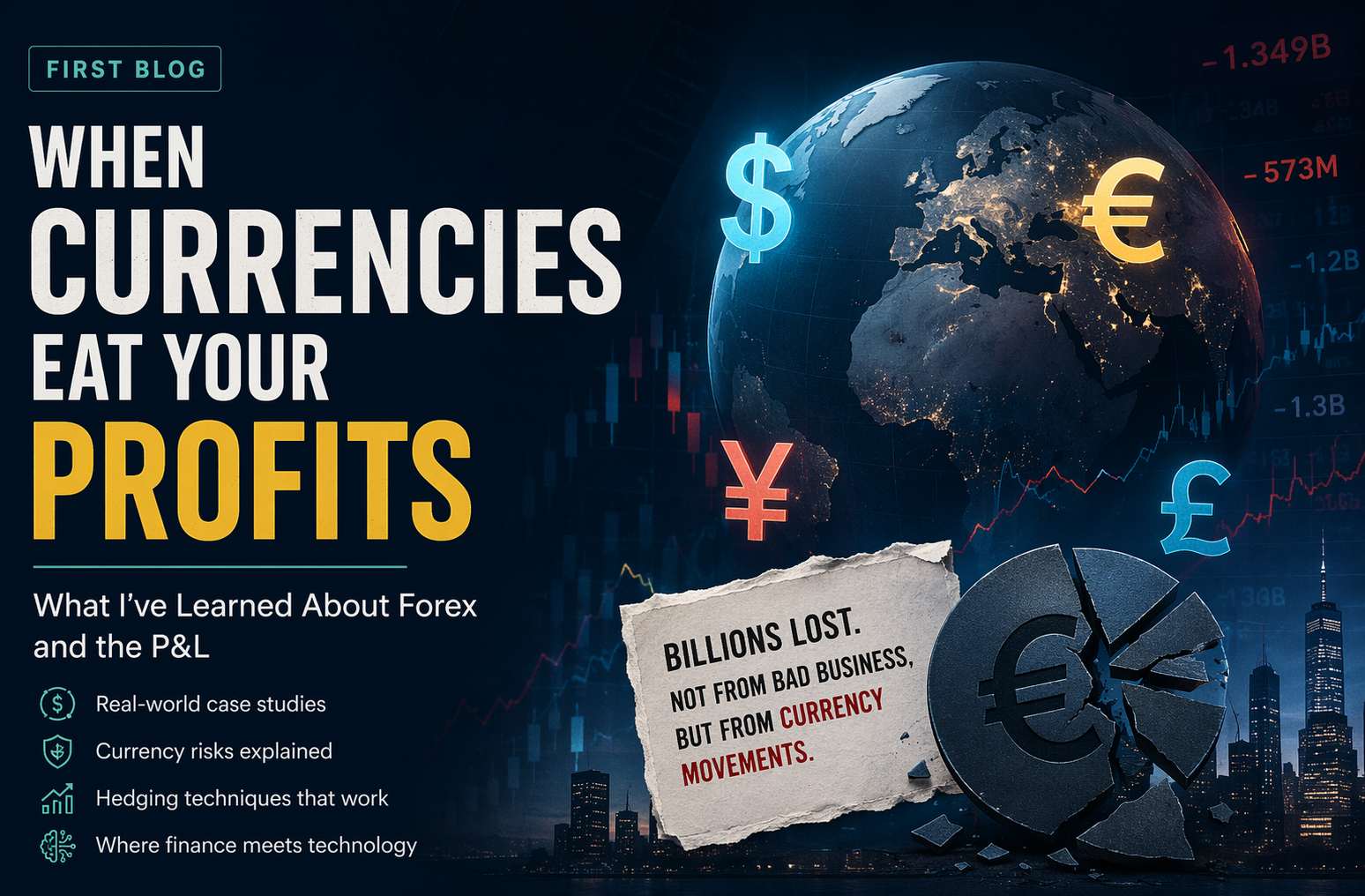
This is my very first blog post. I've been diving deep into the world of finance, data, and technology — and one topic that absolutely caught my attention is something most people outside of finance barely think about: foreign exchange (forex) and its devastating impact on corporate profits.
What surprised me the most? Forex calculation is not as simple as it seems. And the money that large organizations lose to currency fluctuations is staggering — we're talking billions of euros vanishing from balance sheets, not because of bad products or poor strategy, but simply because one currency moved against another.
Let me walk you through what I've learned.
🌍 Why Forex Is More Complex Than You Think
Imagine a multinational company headquartered in Germany. It reports in euros. But its subsidiaries operate in the United States (dollars), Brazil (reais), Japan (yen), and China (yuan). Every single day, transactions happen in multiple currencies — a supplier is paid in USD, a customer pays in EUR, raw materials are sourced in CNY. [financemar...stoday.com]
Now here's the catch: the exchange rate between any two of these currencies changes constantly — driven by central bank policies, geopolitical events, trade deficits, and market sentiment.
So when this company consolidates its books at the end of a quarter, those fluctuations can silently inflate costs, shrink revenues, or distort the entire financial picture. It's not a simple "multiply by the exchange rate" exercise — it involves dealing with three distinct types of risk:
1. Transaction Risk 🔄
The most immediate threat. If a deal is struck today in dollars but payment arrives in 60 days, the exchange rate could shift dramatically in that window. A U.S. exporter invoicing €1 million might expect $1.1 million — but if the euro drops to $1.05 by settlement, they pocket $50,000 less, purely from currency movement. [financemar...stoday.com]
2. Translation Risk 📊
When a parent company consolidates financial statements from foreign subsidiaries, exchange rate changes can distort reported profits — even if the underlying business is thriving. Toyota, for example, saw its reported earnings cut by billions of yen when a weakening dollar reduced the yen value of its U.S. subsidiary's earnings. [financemar...stoday.com]
3. Economic Risk 📉
The long game. A sustained currency shift can structurally reshape a company's competitiveness — making exports too expensive, imports too costly, or entire markets unprofitable. [financemar...stoday.com]
💸 The Real-World Damage: Case Studies That Opened My Eyes
Here's where it gets real. These are publicly reported figures from some of the world's largest companies.
🏭 Bayer AG — €1.3 Billion Lost to Currency Headwinds (2024)
Bayer, the German life sciences giant with €46.6 billion in group sales, reported negative currency effects of approximately €1.349 billion on sales in fiscal year 2024. On top of that, currency headwinds shaved €573 million off EBITDA before special items. [guidechem.com], [quarterlytics.com]
The year before (2023) was even worse: €1.964 billion in negative currency effects on the top line. [guidechem.com]
In the 2025 Annual Report, Bayer explicitly noted that its "operational business was impacted by substantial currency headwinds overall," with the Group even having to revise its guidance mid-year due to "significant currency effects." [reports.bayer.com]
Think about that — a company that grows its sales by +1.1% on a currency-adjusted basis can still appear to shrink in reported terms because forex ate the growth. [bayer.com]
🚗 Volkswagen — A 95% Profit Drop in One Quarter
Perhaps the most famous forex cautionary tale. In January 2004, Volkswagen reported a 95% drop in Q4 2003 profits, which slumped from €1.05 billion to just €50 million. For the full year, operating profit fell by 50%. [studylib.net]
The cause? The euro surged from $1.00 to $1.25 against the dollar in 2003, and VW had made the fateful decision to hedge only 30% of its foreign currency exposure instead of its traditional 70%. Currency losses alone are estimated to have wiped ~€1.2 billion from operating profits. [studylib.net]
VW learned its lesson the hard way and eventually shifted some production facilities to the U.S. — creating a natural hedge where dollar revenues could be matched with dollar costs. [transtutors.com]
✈️ Airbus — €1.2 Billion Forex Loss (2022)
Airbus, which sells planes priced in dollars but incurs most costs in euros, recorded a foreign exchange loss of €1.2 billion in 2022, during a period of extreme euro volatility. [trainy.co]
🍫 Nestlé — CHF 1.3 Billion Hit
Nestlé, the Swiss food giant, suffered a negative currency impact of CHF 1.3 billion on its results — a reminder that even consumer staples companies are not immune. [trainy.co]
🛡️ Techniques to Stop the Profit Leakage
So what can organizations actually do about this? The good news is that there's a well-established toolkit — the challenge lies in choosing the right mix and executing it with discipline.
1. Forward Contracts — Lock In Your Rate
The most widely used instrument. A company agrees today to buy or sell a currency at a fixed rate on a future date. It eliminates uncertainty but also sacrifices any upside if rates move favorably. [corporatef...titute.com], [trainy.co]
2. Currency Options — Flexibility at a Premium
Options give the right (but not the obligation) to exchange at a set rate. If the rate moves against you, you exercise the option. If it moves in your favor, you let it expire and enjoy the market rate. The catch? You pay a premium upfront. Airbus has leaned heavily on options since 2022's euro volatility. [financemar...stoday.com], [trainy.co]
3. Currency Swaps — Long-Term Stability
Two parties exchange cash flows in different currencies over time. Toyota uses currency swaps to manage its exposures in dollars and euros while optimizing financing costs. Research shows swaps can achieve a 41% volatility reduction, though they introduce counterparty credit risk. [atlantis-press.com], [financemar...stoday.com]
4. Natural Hedging — The Smartest Long-Term Play
Match your revenues and expenses in the same currency. Apple earns billions in yuan from iPhone sales in China and spends heavily there on manufacturing — this balance naturally cuts conversion risk. VW eventually adopted this by moving production to the U.S. [financemar...stoday.com], [transtutors.com]
5. AI-Driven Volatility Forecasting 🤖
The cutting edge. AI models are now being used to predict currency moves using economic indicators, market sentiment, and geopolitical signals. Research recommends that companies adopt AI-driven volatility forecasting and blockchain-enabled execution as part of hybrid hedging strategies. [atlantis-press.com]
6. Diversification and Netting
Spreading operations across currencies and netting internal transactions (e.g., offsetting a euro receivable with a euro payable within the group) reduces the volume of currency that actually needs to be converted. [ftitreasury.com]
🧠 Key Takeaways
- Forex is not a rounding error — it's a billion-euro problem. Bayer lost €1.3B in one year. VW lost €1.2B in one year. Airbus, €1.2B. These are not edge cases.
- Hedging is not optional — VW's story proves that under-hedging can be catastrophic. But over-hedging can also lock you out of favorable movements.
- There's no single silver bullet — the best approach is a hybrid strategy: short-term liquidity tools (forwards, options) combined with long-term structural solutions (natural hedging, AI forecasting).
- Forex complexity is underestimated — it's not just "multiply by the rate." Transaction, translation, and economic risks each require different management approaches.
- This is where tech meets finance — AI, blockchain, and data pipelines are transforming how companies forecast and manage currency risk. There's a huge opportunity here.
🚀 What's Next
This was my first attempt at putting my learnings into words, and I'm genuinely excited about exploring this intersection of finance, data, and technology further. If you found this useful — or if you disagree with something — I'd love to hear from you.
Until next time. 🙌